


Investing in passive index funds like SPY, VOO, and IVV (S&P 500 index) has skyrocketed over recent decades, attracting countless investors seeking simplicity and strong returns. Yet, hidden beneath this appealing simplicity lies an overlooked risk: rising concentration in the largest holdings, particularly tech giants. Could your passive investments quietly amplify your risk in uncertain markets?
The Evolution of Passive Investing
Since the launch of SPY in 1993, passive investing has captured investor imagination by delivering impressive returns during prolonged bull markets. Investors flocked to simplicity, low fees, and market-matching returns, particularly during the booming late '90s, the recovery post-2008, and after the COVID-19 downturn.
The Silent Risk – Increasing Concentration
The top 10 holdings now dominate approximately 34% of the S&P 500’s total weight, heavily influenced by tech companies like Apple, Nvidia, and Microsoft. Historically, such market concentration occurred before notable corrections—examples include the dot-com bubble and the financial crisis of 2008. Concentration increases vulnerability, making portfolios heavily susceptible to volatility from just a handful of stocks (Morningstar, 2024).
| Position | Company | Symbol | Weight |
| 1 | Apple Inc. | AAPL | 6.73% |
| 2 | Nvidia Corp | NVDA | 6.04% |
| 3 | Microsoft Corp | MSFT | 5.98% |
| 4 | Amazon.com Inc | AMZN | 3.79% |
| 5 | Meta Platforms, Inc. Class A | META | 2.65% |
| 6 | Berkshire Hathaway Class B | BRK.B | 2.01% |
| 7 | Alphabet Inc. Class A | GOOGL | 1.98% |
| 8 | Broadcom Inc. | AVGO | 1.85% |
| 9 | Alphabet Inc. Class C | GOOG | 1.63% |
| 10 | Jpmorgan Chase & Co. | JPM | 1.40% |
| 11 | Eli Lilly & Co. | LLY | 1.38% |
| 12 | Tesla, Inc. | TSLA | 1.37% |
| 13 | Visa Inc. | V | 1.22% |
| 14 | Exxon Mobil Corporation | XOM | 1.06% |
| 15 | Unitedhealth Group Incorporated | UNH | 0.98% |
| 16 | Mastercard Incorporated | MA | 0.91% |
| 17 | Netflix Inc | NFLX | 0.84% |
| 18 | Costco Wholesale Corp | COST | 0.82% |
Case Study – Tech’s Dominance and Market Corrections
Historically, market corrections hit concentrated indices hardest. The dot-com bubble in 2000 saw tech-heavy portfolios lose up to 70% of their value. Similarly, corrections like the 2008 financial crisis and the rapid COVID-19 crash demonstrated how quickly concentrated holdings amplify losses, highlighting the risks associated with heavily indexed investing (Investopedia, 2017).
Diversification – Actively Managed Portfolios as a Shield
Active management through mutual funds or segregated funds offers vital risk management by utilizing strategies such as sector rotation and tactical asset allocation. Historical data consistently reveals actively managed portfolios reduce volatility, cushioning investor portfolios during market downturns. This approach allows proactive management to shift assets defensively and leverage market opportunities unavailable to passive investors.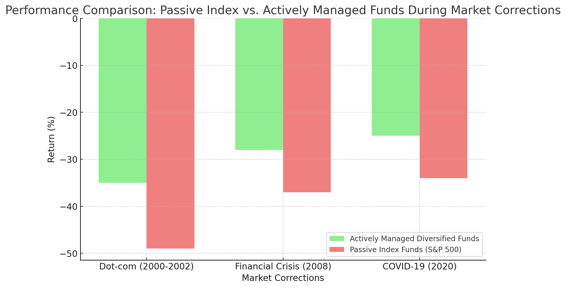
This chart clearly illustrates that actively managed diversified portfolios (green bars) experienced notably smaller losses compared to passive index funds (red bars) during significant market downturns such as the Dot-com crash, the 2008 financial crisis, and the COVID-19 pandemic crash (Fidelity, 2024, Morningstar, 2022).
Passive vs. Active – The Long-term Perspective
While passive investing can thrive during extended bull markets, actively managed diversified portfolios demonstrate higher resilience and superior performance in downturns. Given market cycles are inevitable, managed funds often deliver superior risk-adjusted returns through downturn periods. The cyclical nature of markets suggests that managing downside risks can significantly improve long-term financial outcomes.
What It Means for You – Navigating the Future
Recognizing your exposure to concentrated passive investments is critical. Integrating actively managed portfolios into your investment strategy provides balanced protection against volatility. Additionally, leveraging Dollar-Cost Averaging (DCA) through a financial advisor can turn market volatility into opportunity.
What is DCA? Dollar-Cost Averaging involves regularly investing a fixed amount of money into the markets, regardless of fluctuations. During volatile cycles, when markets swing significantly week-to-week, DCA allows investors to buy more shares when prices are lower, and fewer shares when prices rise. This disciplined strategy reduces average cost per share over time, potentially boosting long-term returns and significantly mitigating short-term market risks (Investopedia, DCA Explained).
Call to Action
Now is the time to reevaluate your portfolio strategy. Book your complimentary portfolio consultation today and discover how proactive management and disciplined strategies like DCA can protect your wealth and boost your financial independence. Together, we can ensure your financial future is more secure, diversified, and resilient.
Conclusion
Remember, markets reward preparation, not reaction. Take control, embrace strategic diversification, and secure your financial independence.
#investment #financialliteracy #financialindependence #professionaldevelopment #wealth #businessowner #entrepreneurship #lifestyle