


In the quest for financial growth, savvy investors are often on the lookout for opportunities to minimize costs and maximize returns. One common misconception in this pursuit is the idea that a low Management Expense Ratio (MER) is a surefire path to wealth accumulation. However, a closer examination of investment strategies and long-term outcomes suggests that the value provided by a seasoned financial advisor, who collaborates with professional fund managers, can far outweigh the allure of lower fees.
Understanding MER
The MER is a measure of the total costs necessary to run a mutual fund, expressed as a percentage of the fund's total assets. These expenses include management fees, administrative costs, and sometimes marketing fees. While it's logical to assume that a lower MER means more money in your pocket, this view fails to account for the potential higher returns that can be generated through expert fund management.
Expert Fund Management vs. Self-Management: A Closer Look
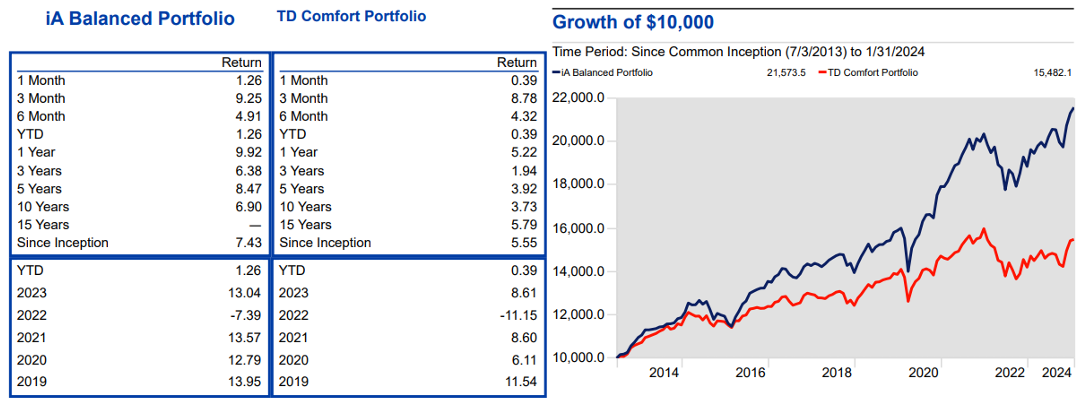
Consider, for comparison, the Industrial Alliance Balanced Portfolio, a professionally managed fund that, despite a higher MER of 2.61%, consistently outperforms a comparable non-managed fund from TD bank with an MER: 1.91%, as shown in the illustration. This superior performance can be attributed to the fund manager's expertise in asset selection, market analysis, and timing. Conversely, self-managed portfolios can often lag behind, even with lower expenses.
Reference:
The performance of the funds mentioned in the example can be monitored on MorningStar by clicking the links under the heading "MorningStar Performance" below. You may also find the solution provider's fund fact sheets under the supplier named column.
| TD Wealth Management | MorningStar Performance | Industrial Alliance | MorningStar Performance |
| TD Fund Fact | TD Comfort Balanced Portfolio | TD Comfort Balanced Portfolio |
Advantages of Professional Fund Management
-
Diversification: Financial advisors and fund managers can create a diversified portfolio that mitigates risk while capturing growth across different sectors and geographies.
-
Expertise: Fund managers have access to information, tools, and resources that individual investors may lack. Their ability to interpret market data and adjust investment strategies accordingly can be a significant advantage.
-
Time Savings: By entrusting your portfolio to a financial advisor and fund manager, you save the considerable time and effort that comes with managing your own investments.
-
Psychological Ease: The emotional toll of investing can be significant. Professionals can provide a buffer against making impulsive decisions based on fear or greed.
The Cost of Low MERs
Investors who focus solely on MERs might save on fees in the short term but miss out on potential gains that professional management can provide. As the iA Balanced Portfolio illustration demonstrates, a fund's growth over time should be the true measure of its value. The slight increase in MER is often a small price to pay for the peace of mind and potential returns offered by expert management.
Conclusion
Before you decide to go it alone in the investment world, attracted by low fees, consider the full picture. The guidance of a financial advisor and the acumen of a seasoned fund manager can not only increase your chances of financial success but also free you from the daily burdens of investment management. It's not just about how much you pay, but also about the value you receive for what you pay.
In the end, investing should not be a short-sighted journey but a strategic move towards financial independence. As I will advocate, don't just judge a fund by its MER; consider the legacy of prosperity that expert financial guidance can help sculpt across generations.